
IoT Connectivity: How to Choose Between BLE, Wi-Fi, Thread, LoRaWAN, NB-IoT and LTE-M
30 October 2026 · 8 min read · akranIQ
Why IoT connectivity is the decision that shapes everything else
A device becomes smart the moment it can share what it senses and receive what it should do next. The radio you pick for that decides more of your product than almost any other choice: battery life, bill of materials, monthly running cost, certification effort and even the enclosure.
It is also one of the hardest choices to reverse. Changing from BLE to NB-IoT after launch means a new module, new antenna, new firmware stack, new certification and often a new board. Get it right on paper first.
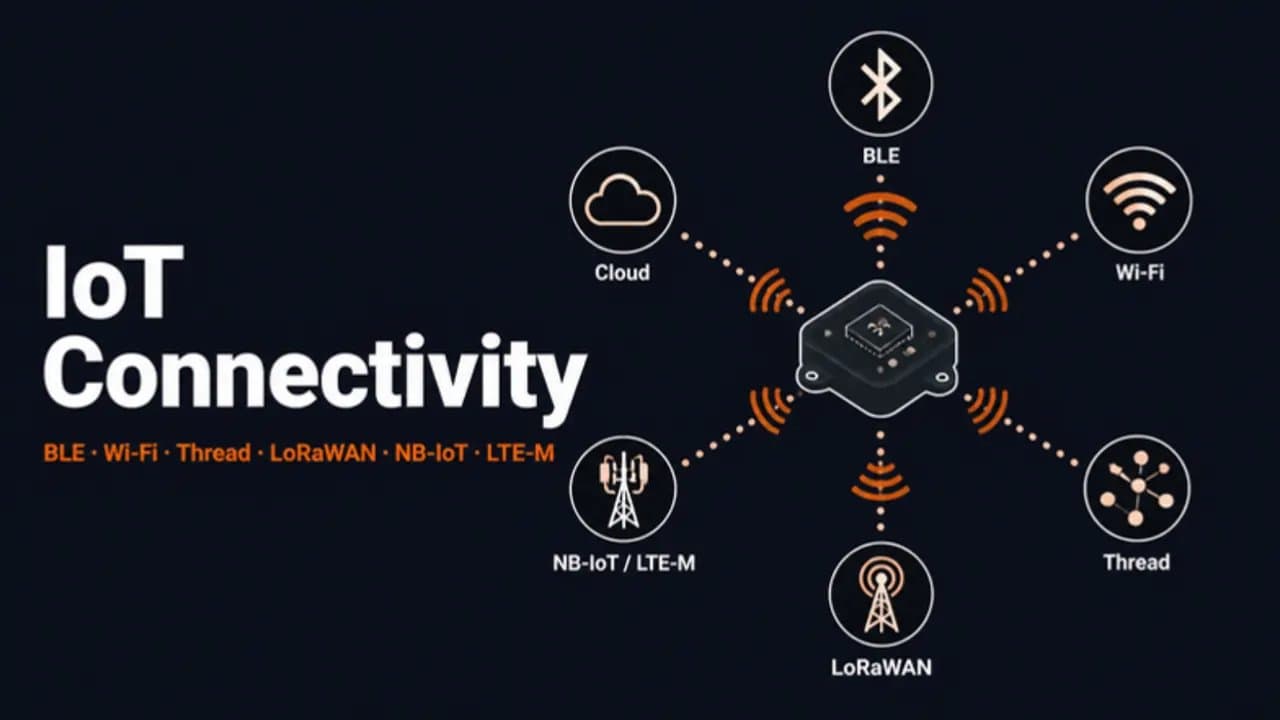
This guide compares the six options teams most often weigh: BLE, Wi-Fi, Thread (with Matter), LoRaWAN, NB-IoT and LTE-M. It starts with the questions that narrow the field, then compares each option, then shows which fits which kind of device.
Five questions that decide your IoT connectivity
Answer these before comparing radios. Most projects rule out four of the six options here.
- How far is the device from the nearest network? A phone or gateway in the same room points to BLE, Wi-Fi or Thread. A field, a pipeline or a moving vehicle points to LPWAN or cellular IoT.
- How much data, how often? A temperature reading every 15 minutes is a few bytes. A firmware image or a camera frame is megabytes. Long-range low-power radios are built for the first, not the second.
- What powers it, and for how long? Mains power makes Wi-Fi easy. A coin cell that must last years rules it out.
- Does it move? Devices that cross cell boundaries at speed need handover, which LTE-M supports and NB-IoT handles poorly.
- Who owns the network? Wi-Fi and Thread use the customer's infrastructure. LoRaWAN can be your own gateways or a public network. NB-IoT and LTE-M need an operator, a SIM and a data plan, but no infrastructure from you.
Short range: BLE vs Wi-Fi vs Thread and Matter
Short-range radios are cheap and need no subscription, but the device needs something nearby to reach the internet: a phone, a router or a border router.
Bluetooth Low Energy (BLE)
BLE is the default for wearables, medical sensors and anything that pairs with a phone. It runs for months or years on a coin cell and every smartphone already supports it. The catch is that the phone is the gateway: when the phone is away, the device is offline. Bluetooth Mesh extends coverage across a building, but adoption outside lighting is limited.
Wi-Fi
Wi-Fi gives high throughput and direct internet access through the customer's router. It suits mains-powered devices such as appliances, cameras and HVAC controllers. It is a poor fit for batteries, and onboarding (getting the device onto the customer's network) is the step where many products lose users.
BLE vs Wi-Fi
Choose BLE when battery life and phone pairing matter more than data volume. Choose Wi-Fi when the device has mains power and must reach the cloud without a phone. Many products use both: BLE to set up the device, Wi-Fi to run it.
Thread and Matter
Thread is a low-power IPv6 mesh network: devices relay for each other, and a border router (often a smart speaker or hub) connects the mesh to the internet. Matter is not a radio. It is an application standard that runs over Thread, Wi-Fi or Ethernet, and uses BLE to commission new devices.
So Thread vs Bluetooth is a real choice of network, while Matter vs Bluetooth is a category mix-up: a Matter device often contains Bluetooth. Pick Thread with Matter for smart-home products that must work across ecosystems. Pick BLE when the device talks to your own app.
Long range: LPWAN and cellular IoT
LPWAN (low-power wide-area network) radios trade data rate for range and battery life. A device can send small messages over kilometres for years on one battery. There are two families: LoRaWAN on unlicensed spectrum, and cellular IoT (NB-IoT and LTE-M) on operators' licensed networks.
LoRaWAN
LoRaWAN runs on unlicensed sub-GHz bands (868 MHz in Europe and India, 915 MHz in the US). You can install your own gateways, which makes it attractive for farms, campuses, utilities and smart-meter retrofits where you control the site. Payloads are small, typically tens to a couple of hundred bytes, and downlink capacity is limited, so treat it as a sensor network, not a two-way data link.
NB-IoT
NB-IoT runs inside operators' LTE networks in a narrow slice of licensed spectrum. It reaches deep indoors and underground (meter rooms, basements) and needs no gateway from you, only a SIM and a plan. It is built for stationary devices that send small, infrequent messages. Network availability varies by country and operator, and some operators have retired NB-IoT, so check coverage and roadmap before committing.
LTE-M
LTE-M (also called Cat-M1) is the higher-capacity cellular IoT option. It is faster than NB-IoT, supports handover between cells, and has lower latency, which makes it the usual choice for trackers, wearables with cellular, and anything that moves. Firmware updates over LTE-M are practical in a way they rarely are over NB-IoT or LoRaWAN.
LoRaWAN vs NB-IoT
Choose LoRaWAN when you can place gateways, want no per-device subscription, and send small readings. Choose NB-IoT when devices are spread across a city or country, must work deep indoors, and you would rather pay an operator than run a network.
LTE-M vs NB-IoT
Choose LTE-M when the device moves, needs more data, or must receive firmware updates over the air. Choose NB-IoT for fixed devices that send a few bytes a day and must last a decade on a battery. Many modules support both, so you can decide per market.
IoT connectivity compared
Typical values; real range and battery life depend on region, configuration, antenna and how often the device transmits.
| Option | Typical range | Typical data rate | Battery life | Needs | Recurring cost | Best for |
|---|---|---|---|---|---|---|
| BLE | 10–100 m | Up to 1–2 Mbps | Months to years (coin cell) | Phone or gateway nearby | None | Wearables, medical sensors, phone accessories |
| Wi-Fi | 30–50 m indoors | Tens to hundreds of Mbps | Hours to days; usually mains | Customer's router | None | Appliances, cameras, HVAC |
| Thread (+ Matter) | 10–30 m per hop, extended by mesh | 250 kbps | Years for sleepy end devices | Border router (hub or speaker) | None | Smart-home devices, building sensors |
| LoRaWAN | 2–5 km urban, 10+ km rural | 0.3–50 kbps | 5–10 years | Your gateways or a public network | Gateway or network fee | Agriculture, utilities, campus sensors |
| NB-IoT | Operator coverage, strong indoors | Tens of kbps | Up to 10 years | SIM and operator coverage | Data plan per device | Smart meters, fixed infrastructure |
| LTE-M | Operator coverage | Up to about 1 Mbps | Years | SIM and operator coverage | Data plan per device | Trackers, mobile assets, devices needing OTA updates |
Which IoT connectivity fits your device
| Device | Usual choice | Why |
|---|---|---|
| Wearable health monitor | BLE, LTE-M for standalone models | Phone does the heavy lifting; LTE-M when it must work without one |
| Smart thermostat or lock | Thread with Matter, or Wi-Fi | Works across smart-home ecosystems |
| Industrial machine monitor | Wi-Fi or Ethernet to an edge gateway | Mains power, high data, plant network on site |
| Retrofitted electricity, water or gas meter | NB-IoT or LoRaWAN | Small readings, deep indoor coverage, long battery life |
| Farm or environmental sensor | LoRaWAN | Wide area, no cellular coverage needed, own gateways |
| Vehicle or asset tracker | LTE-M | Moves between cells; needs OTA updates |
| EV battery or e-scooter | LTE-M plus BLE | Cloud diagnostics on the move; BLE for service tools |
Hybrid designs are normal
Most real products combine radios. BLE handles setup and local service, while Wi-Fi, LoRaWAN or LTE-M carries data to the cloud. A gateway often bridges local Thread or BLE devices to a cellular uplink. Plan the firmware so each radio is a module behind a clean interface; then swapping NB-IoT for LTE-M in one market is a configuration change, not a redesign.
Mistakes that force a redesign
- Choosing on range alone. A radio that reaches the gateway but drains the battery in three months still fails. Model power use from your real transmit schedule, not the datasheet headline.
- Forgetting firmware updates. Every connected device will need patches. Over-the-air (OTA) updates need enough bandwidth to deliver an image, flash space for a second copy, and rollback if the update fails. LoRaWAN and NB-IoT make full-image OTA slow or impractical; plan for it before you pick them. Our guide to OTA and FOTA updates covers how to do it safely.
- Skipping secure boot and device identity. A smart device that accepts unsigned firmware can be taken over. Secure boot, signed updates and a unique identity per device are cheaper to design in than to add after a breach.
- Ignoring certification and operators. Cellular modules need carrier certification in many markets, and network availability differs by country. Budget time for both.
- Hard-wiring one radio into the application. Keep connectivity behind a clean interface in the firmware so a new market or a retired network does not mean rewriting the product.
IoT connectivity: frequently asked questions
What is the best IoT connectivity option? There is no single best option. Short-range devices near a phone or router suit BLE, Wi-Fi or Thread; devices spread over a wide area suit LoRaWAN, NB-IoT or LTE-M. Range, data volume, power and mobility decide it.
Is LoRaWAN better than NB-IoT? LoRaWAN is better when you can run your own gateways and want no per-device subscription. NB-IoT is better for devices spread across a city that must work deep indoors without your own infrastructure.
What is the difference between LTE-M and NB-IoT? LTE-M is faster, supports moving devices and makes firmware updates practical. NB-IoT uses less spectrum, reaches deeper indoors and suits fixed devices sending small, infrequent messages.
Is Matter a replacement for Bluetooth? No. Matter is an application standard that runs over Thread, Wi-Fi or Ethernet, and it uses Bluetooth LE to set up new devices.
What is LPWAN? LPWAN (low-power wide-area network) is a class of radios, including LoRaWAN, NB-IoT and LTE-M, that send small amounts of data over long distances with years of battery life.
Need help choosing?
akranIQ engineers the software that makes hardware smart, from firmware and connectivity stacks to secure OTA updates and the cloud behind them. If you are deciding how your device should connect, talk to our embedded team or see our embedded software and IoT development services.
Want to add AI or IoT to a device you already make? See how our AIoT and edge AI development team in India works.